
Sherman County Criminal Court Cases
Sherman County criminal court cases split by charge level. The 69th Judicial District Court hears felonies. Class A and Class B misdemeanors ordinarily proceed in constitutional county court. The Justice of the Peace and Stratford Municipal Court handle the fine-only matters within their own jurisdiction. That division matters because a search of one court cannot rule out a file in another.
The combined County and District Clerk keeps the local county and district case files. The district judge's administrative office is in Dumas, yet Sherman County filings remain with the clerk in Stratford and are heard locally when set. County Attorney David Holmes handles the county prosecution layer, while District Attorney Erin Lands Anchondo's office handles felony prosecution for the 69th Judicial District. A police report or booking sheet may precede a court case, but neither is the clerk's docket.
Sherman County Criminal Case Clerk
The combined clerk's office is the source of official Sherman County criminal case records. Laura Rogers's counter is at 701 North 3rd Street, Stratford, TX 79084. It is open Monday through Thursday from 8 a.m. to 5 p.m. and Friday from 8 a.m. to noon, including the lunch hour. Call 806-366-2371 before traveling if a file is old, sensitive, or needed in certified form.
The clerk page states that official county records are available only in and from that office. This distinction is important when a portal displays an index entry but not the signed instrument. Ask for a named item, such as the indictment, information, docket sheet, judgment, sentence, or bond order. A focused request is easier to fill than a demand for every paper in a file.
The county clerk page shows the office and its iDocket route:
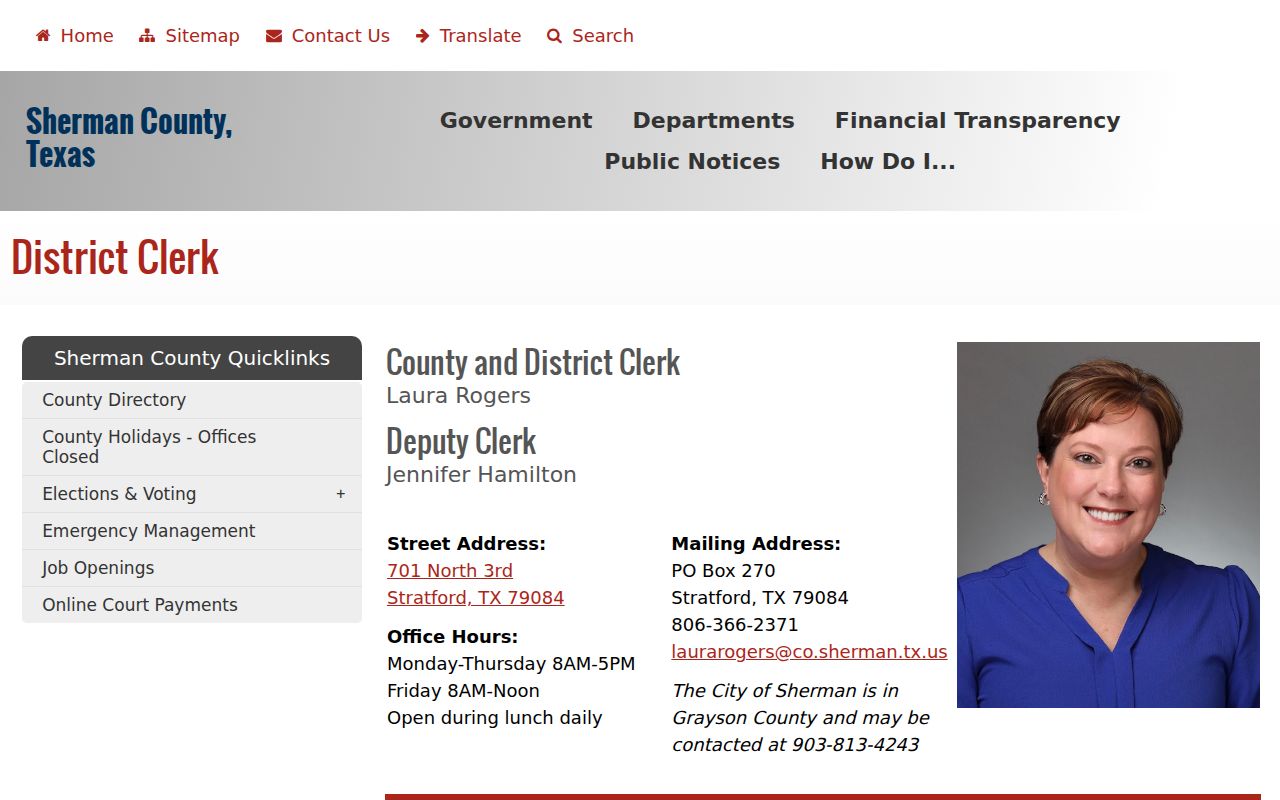
The page reinforces why a portal result should lead back to the Stratford counter for an official copy.
Searching Sherman County Case Records
The clerk designates iDocket for online case research. Vendor registration or subscription terms may apply, and the county has not published a complete field guide. Use the screen as a discovery tool, then confirm the result with the combined clerk.
- Select Sherman County in iDocket so the search does not drift to Sherman city in Grayson County.
- Enter the available party name or cause-number criteria and compare spelling carefully.
- Record the court, cause number, case type, status, and party display from a likely result.
- Read the docket chronology for filing, hearing, plea, and judgment entries without assuming an entry title tells the full result.
- Call or write the clerk for the docket sheet and the exact official document needed, including certification when necessary.
| Field or control | Type | Required | Use |
|---|---|---|---|
| County | Dropdown | Yes | Select Sherman County; do not choose Sherman city records. |
| Name or case criteria | Text | Not published | Use the live interface; access may require an account or payment. |
| re:SearchTX search | Text | For keyword route | Search by terms, then narrow with available filters. |
| re:SearchTX tabs | Tabs | No | Cases, filings, document text, and hearings are separate views. |
| County and court filters | Filters | No | Limit broad state results to the likely venue. |
A view of the local clerk-designated portal helps identify the correct service:

Keep the cause number from the portal because it gives the clerk a precise key for locating the local file.
Sherman County Felony Case Routing
The 69th District Court creates a geographic trap. Its administrative chambers are at the Moore County Courthouse in Dumas, but a Sherman County felony file does not move there for record custody. The Sherman combined clerk remains the local filing and copy office. The district attorney also works from Dumas, while hearings for Sherman cases are scheduled locally.
This office image comes from the official district court page:
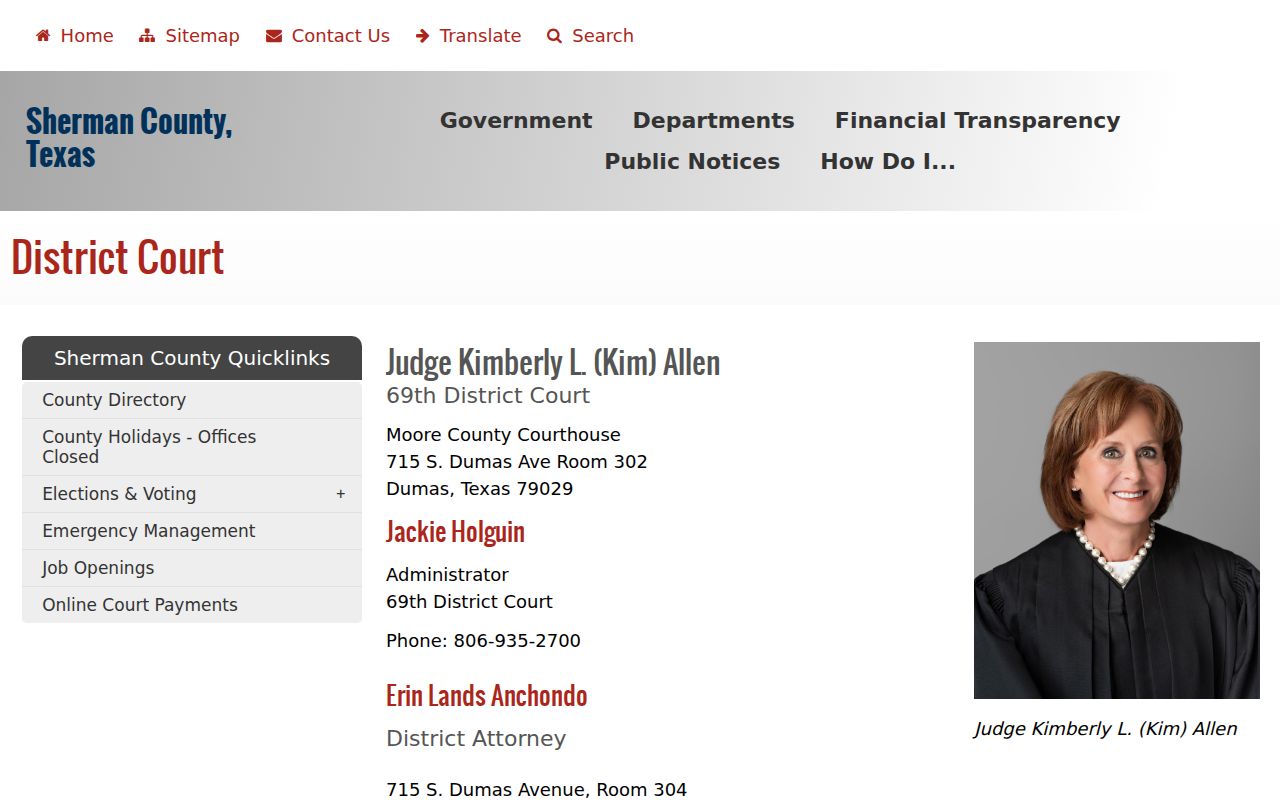
It identifies the court and prosecutor contacts without changing where the public obtains Sherman County docket papers.
Sherman County is not Sherman city. The city of Sherman is in Grayson County, so select the county and verify the clerk before relying on a search result.
Inside a Sherman County Case File
A Sherman County criminal case file links the filed accusation to later court action. The most useful paper depends on the question. An indictment or information states what was formally charged. The docket shows the sequence of settings and filings. A signed judgment records the disposition and sentence more reliably than a short portal label.
| Cause Number & Court | Identifies the local file, venue, case type, filing date, and current status. |
|---|---|
| Charging Document | A complaint, information, or indictment states the formal allegation, statute, and charge class. |
| Docket Entries | Chronological entries may show motions, counsel, continuances, pleas, settings, and post-judgment action. |
| Hearing Dates | Lists scheduled event type, date, and time when the public view supplies them. |
| Disposition & Judgment | Shows dismissal, plea, acquittal, conviction, or another resolved outcome in the signed record. |
| Sentence & Conditions | May state confinement, community supervision, fine, costs, restitution, or credit for time served. |
Bond and balance fields can change. Verify a live amount or active setting with the clerk rather than using an old docket display as payment instruction.
When State Court Search Falls Short
re:SearchTX is Texas's electronic court-record platform, but Sherman County research should not treat it as a complete criminal index. The Texas Judicial Council has reported historic limits in its criminal corpus. If a Sherman County case does not appear, return to iDocket and the combined clerk instead of declaring that no file exists.
The state login and search interface shows the statewide layer:
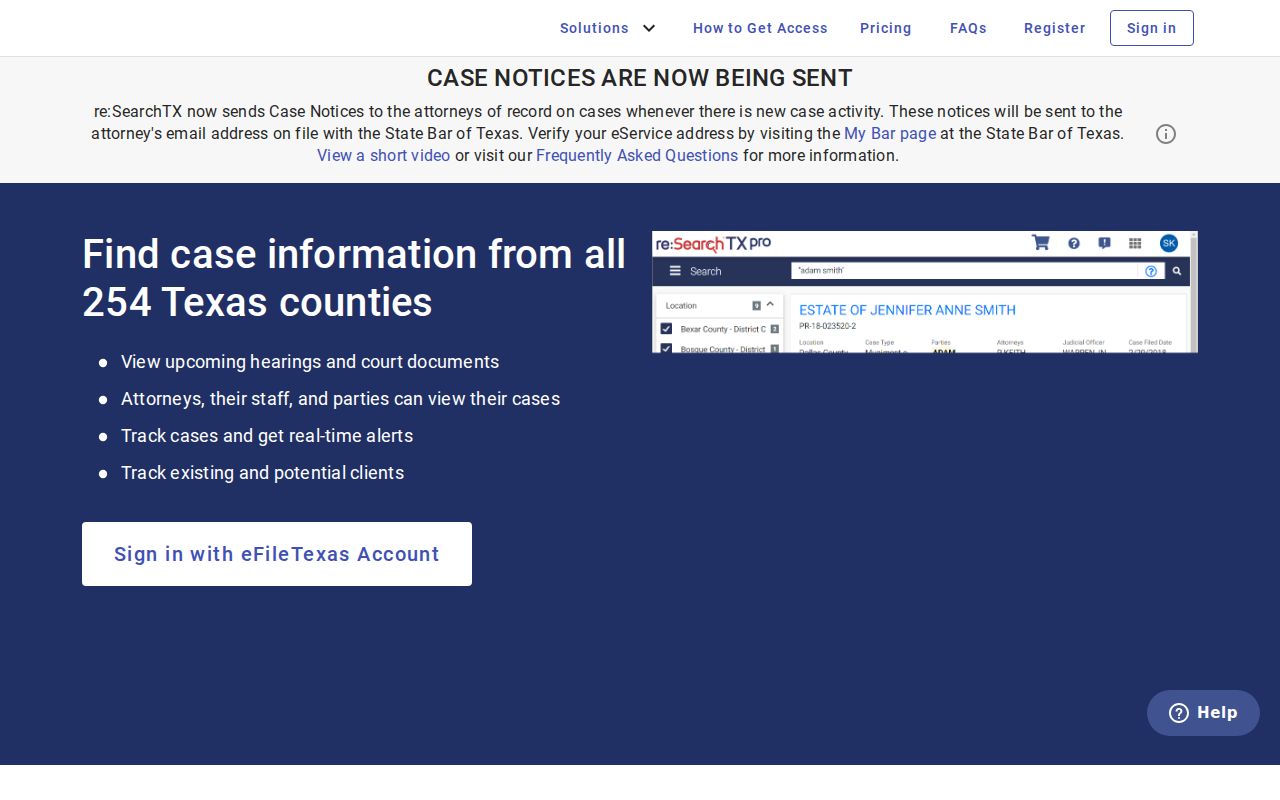
Its county, court, case, party, filing, and hearing refinements can narrow a lead, but only the holding clerk can confirm completeness.
Note: A portal no-hit can reflect coverage, timing, spelling, court level, a restricted record, or an unfiled arrest rather than no case.
How a Criminal Case Moves
A Sherman County arrest can create agency and jail records before any prosecutor files a charge. Magistration addresses warnings, rights, counsel, and bail issues. The county attorney then evaluates applicable misdemeanors, while the 69th District Attorney evaluates felonies. A felony accusation may proceed through a grand jury. A true bill means an indictment was returned; it does not mean the accused was found guilty.
At arraignment, the court records a plea. Pretrial entries may track counsel, discovery, motions, bond changes, and settings. Resolution can come through dismissal, plea, bench trial, or jury trial. Post-judgment entries may cover appeal, modification, revocation, adjudication, discharge, or later record relief.
Case flow: Charges Filed › Arraignment › Pretrial › Plea or Trial › Disposition › Sentencing
Sherman County Docket Outcome Terms
Short docket labels need context. Read them beside the signed order because similar words can mark very different stages in a Sherman County criminal case.
- No bill
- The grand jury declined to return an indictment. It is not an acquittal after trial.
- Dismissal
- The charge ended without a conviction on that count, subject to the actual order and any related case.
- Deferred adjudication
- The court defers a finding of guilt while the person completes ordered community supervision.
- Conviction
- A judgment of guilt entered through a plea or trial result.
- Disposition
- The recorded outcome of a charge or case.
An arrest charge can differ from the filed charge, and the filed charge can differ again from the final judgment. For the preceding custody event, use the county arrest lookup routes; for the court result, obtain the signed Sherman County record.
Sherman County Federal Case Layer
Federal matters are separate. Sherman County is assigned to the U.S. District Court for the Northern District of Texas, not the Eastern District courthouse located in Sherman city. The Northern District county assignment page confirms the correct federal district:
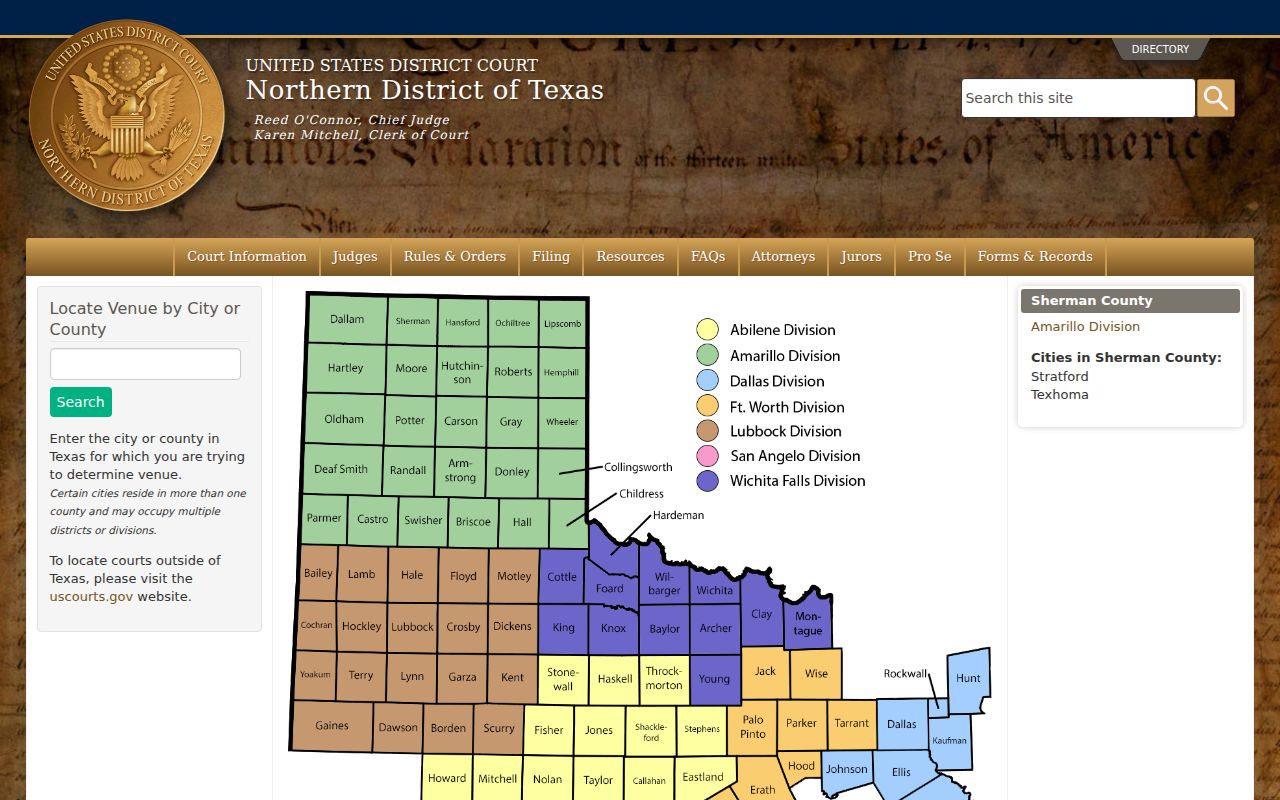
This prevents a same-name error that can send a federal docket request to the wrong district.
Official federal dockets are accessed through PACER, which requires registration and uses the current federal fee schedule. The PACER home interface is shown from its official source:
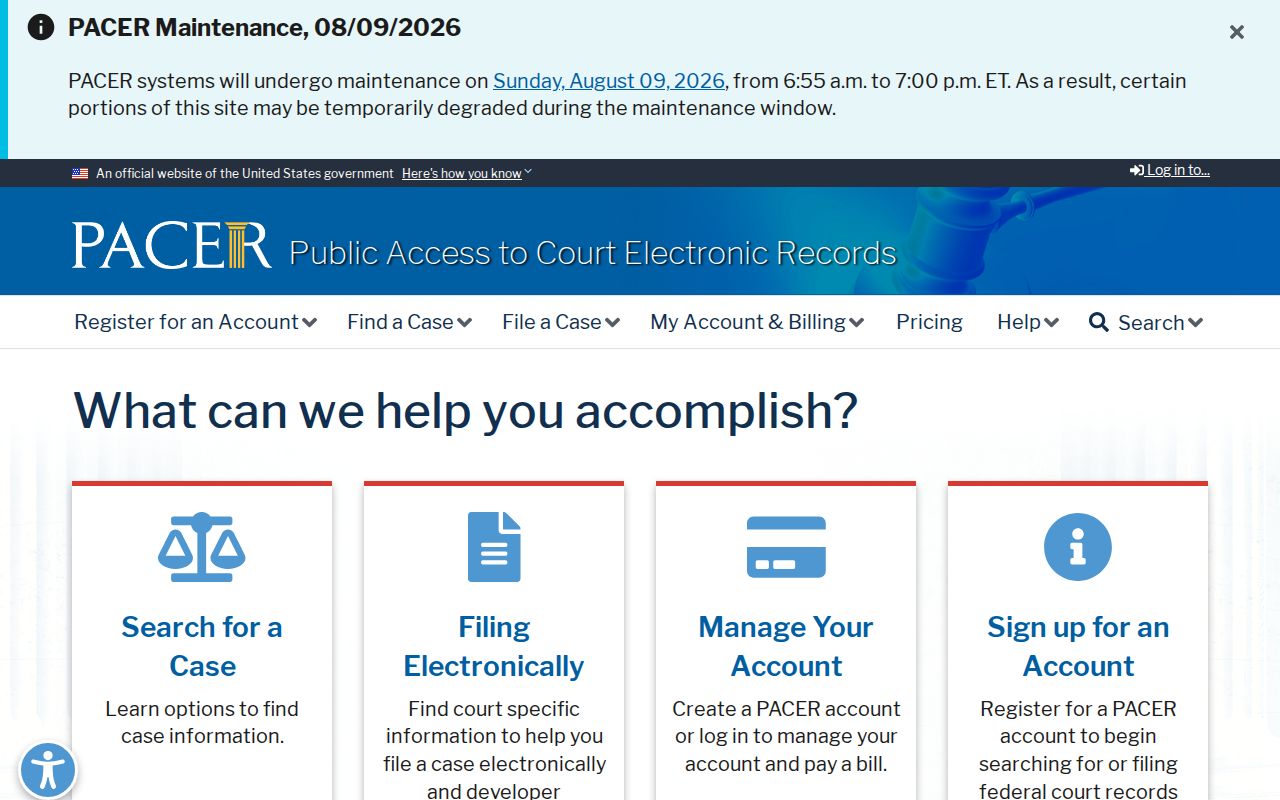
A PACER docket does not replace a Sherman County clerk file because state and federal courts maintain separate systems.
Case Record Access & Restrictions
Texas court case records come from the court or clerk. They are not processed in the same way as executive-agency requests under the Texas Public Information Act. The Texas judiciary's open-records policy explains that Rule 12 applies to administrative judicial records, while adjudicative case records remain with the court that holds them.
Public access does not expose every field. Juvenile records, sealed material, records subject to expunction, victim-identifying data, dates of birth, protected personal identifiers, and sensitive documents can be withheld, restricted, or redacted. The clerk publishes a policy for inspecting sensitive documents in person. If an online document is gated, ask about inspection rules, identification, appointments, copy charges, and certification. Do not infer the paper's contents from its docket title.
For executive-agency material, the Texas Public Information Act supplies the general public-information framework. Court-file access remains a direct request to the clerk. An order of nondisclosure can limit public release without destroying every record, while an expunction under Chapter 55A has a different legal effect.
Note: Confirm a restricted or missing Sherman County case with the clerk before assuming that an online absence states the legal outcome.